

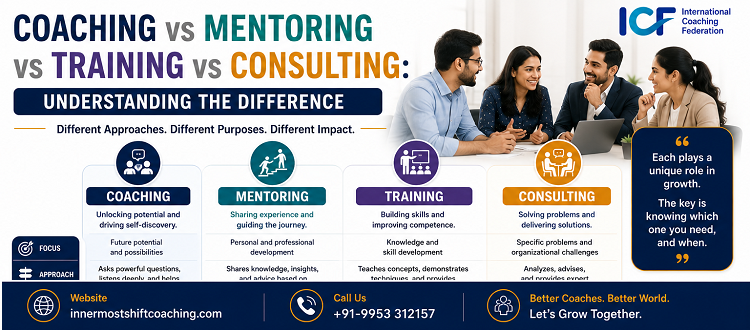
06 Jul Coaching vs Mentoring vs Training vs Consulting: Understanding the Difference
Why Choosing the Right Development Approach Matters
In today’s workplace, organizations invest heavily in developing leaders, employees, and teams.
As a result, terms such as coaching, mentoring, training, and consulting are often used interchangeably.
A manager may say, “I need coaching.”
An organization may request a training program when what it actually needs is consulting.
A leader may seek mentoring but call it coaching.
While these approaches share a common goal of supporting growth and performance, they are fundamentally different in purpose, methodology, and outcomes.
Understanding these differences helps individuals and organizations choose the right intervention for the right challenge.
The question is not:
Which approach is best?
The better question is:
Which approach is most appropriate for the situation at hand?
What Is Training?
Training focuses on transferring knowledge, skills, and information.
The trainer is typically the subject matter expert.
The learner attends because there is something they need to learn or improve.
The trainer’s responsibility is to teach.
The learner’s responsibility is to absorb, understand, and apply the information.
Training Is Most Effective When:
- New skills need to be developed
- Knowledge gaps exist
- Standard processes must be learned
- Technical expertise needs to be transferred
Example
A manager attends a workshop on effective feedback.
The trainer introduces a feedback model, explains its application, demonstrates examples, and facilitates practice.
The objective is skill acquisition.
Training Answers:
- What should I know?
- What skills do I need?
- How is this done?
What Is Consulting?
Consulting focuses on solving problems through expertise.
The consultant is hired because they possess specialized knowledge, experience, or technical capability that the client does not have internally.
Unlike a trainer who teaches people how to do something, a consultant often diagnoses the situation and recommends solutions.
Consulting Is Most Effective When:
- Expertise is required
- A business problem needs solving
- Specialized knowledge is unavailable internally
- External perspective is valuable
Example
A company hires a consultant to redesign its sales process.
The consultant studies the current system, identifies issues, and recommends improvements.
The client implements the recommendations.
Consulting Answers:
- What should we do?
- What solution do you recommend?
- How can this problem be solved?
What Is Mentoring?
Mentoring is built upon experience.
A mentor has travelled a path that the mentee wishes to explore.
The mentor shares wisdom, lessons, guidance, and insights gained through personal experience.
Mentoring often involves advice and recommendations.
This is not a weakness of mentoring.
It is one of its greatest strengths.
Mentoring Is Most Effective When:
- Experience matters
- Career guidance is needed
- Industry knowledge is valuable
- Someone wishes to learn from another person’s journey
Example
A first-time CHRO receives guidance from a seasoned CHRO who has navigated leadership transitions, board relationships, organizational politics, and talent challenges.
The mentor shares experiences and practical wisdom.
Mentoring Answers:
- What have you learned?
- What would you do in my situation?
- What should I be aware of?
What Is Coaching?
Coaching takes a fundamentally different approach.
Rather than teaching, advising, or recommending solutions, coaching focuses on facilitating awareness, thinking, learning, and growth.
Professional coaching operates from a powerful assumption:
People are often more capable, resourceful, and creative than they realize.
The coach does not need to provide the answers.
The coach helps the client discover their own answers.
Coaching Is Most Effective When:
- Awareness is needed
- Thinking needs to expand
- Decision-making requires clarity
- Behaviour change is desired
- Leadership effectiveness needs to improve
- Growth and development are the focus
Example
A leader struggles with delegation.
Rather than advising the leader what to do, the coach explores:
- What makes delegation difficult?
- What assumptions are operating?
- What fears exist?
- What alternatives are possible?
The leader develops new awareness and creates their own path forward.
Coaching Answers:
- What are you noticing?
- What options exist?
- What matters most?
- What are you learning?
- What will you do?
A Simple Comparison
| Approach | Primary Role | Primary Focus | Provides Answers? |
| Training | Teacher | Knowledge & Skills | Yes |
| Consulting | Expert | Solutions | Yes |
| Mentoring | Experienced Guide | Wisdom & Experience | Often Yes |
| Coaching | Thinking Partner | Awareness & Growth | No |
Why Coaching Has Grown So Rapidly
For many years, organizations primarily relied on training and consulting.
These approaches remain valuable today.
However, modern workplaces face increasing complexity.
Leaders encounter situations where there may not be a single correct answer.
Employees are expected to think independently.
Organizations need innovation, adaptability, and ownership.
In such environments, awareness becomes more important than instruction.
This is one reason coaching has become one of the fastest-growing professions globally.
Coaching helps people:
- Think more clearly
- Develop ownership
- Expand awareness
- Improve decision-making
- Create sustainable behavioural change
Rather than depending on external answers, individuals learn to access their own wisdom and capability.
The Best Leaders Know When to Use Each Approach
A common mistake is assuming one approach is superior to another.
In reality, each serves a valuable purpose.
Exceptional leaders know when to:
Train
When knowledge or skills are missing.
Consult
When expertise is required.
Mentor
When experience and wisdom can accelerate learning.
Coach
When awareness, ownership, and growth are needed.
Leadership effectiveness often depends on choosing the right approach at the right moment.
Where Does NLP Fit?
Many coaches study disciplines such as Neuro-Linguistic Programming (NLP) to deepen their understanding of human behaviour.
NLP is not a replacement for coaching.
Rather, it provides insights into:
- Communication patterns
- Belief systems
- Behavioural preferences
- Decision-making processes
- Personal change
When integrated ethically and appropriately, NLP can help coaches facilitate deeper awareness and support meaningful transformation.
At AlphaStars Academy of Excellence, coach education integrates professional coaching competencies with authentic NLP certification, helping participants understand both the coaching process and the human patterns that influence behaviour and change.
Final Thoughts
Training teaches.
Consulting advises.
Mentoring guides.
Coaching awakens awareness.
Each approach has a valuable role to play in individual and organizational development.
The key is not choosing one over the others.
The key is understanding when each approach creates the greatest value.
As workplaces become increasingly complex and leaders face challenges with no obvious answers, coaching continues to grow because it helps people develop the awareness, thinking, and capability needed to navigate uncertainty and create meaningful change.
And perhaps that is why coaching is becoming such an essential leadership skill in today’s world.
About AlphaStars Academy of Excellence
AlphaStars Academy of Excellence provides ICF-accredited coach education that integrates professional coaching competencies with the InnerMost Shift™ Coaching Model, authentic NLP certification, leadership development, emotional intelligence, and transformational learning.
Participants learn directly from the founders and developers of the methodology, including Siri Guru Prakash Kaur Khalsa (MCC), Sat Puram Singh Khalsa (MCC), and Prosperity Jhunjhunwala (PCC). Through coach education, mentoring, supervision, and experiential learning, participants develop coaching competence, leadership capability, and a deeper understanding of human behaviour and transformation.
Sorry, the comment form is closed at this time.