

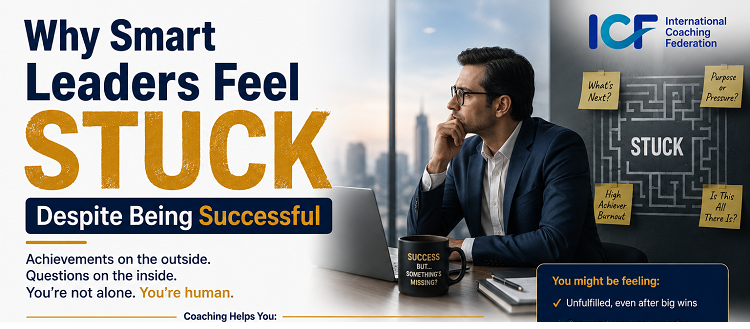
22 Jun Why Success Doesn’t Always Stop Leaders From Feeling Stuck
Success on the Outside. Stuck on the Inside.
From the outside, they appear to have it all.
They lead large teams. They make important decisions. They are respected by colleagues. They have achieved positions that many aspire to reach.
Yet, when the coaching conversation begins, a different story often emerges.
They feel exhausted.
They feel overwhelmed.
They feel trapped in endless meetings, constant demands, and competing priorities.
Some describe it as running faster but getting nowhere.
Others say they feel like they are carrying the weight of the organization on their shoulders.
Many are surprised by a simple realization:
Success and progress are not always the same thing.
A leader can continue achieving results while simultaneously feeling stuck.
The Paradox of Leadership Success
One of the biggest myths about leadership is that greater success automatically creates greater freedom.
In reality, success often creates new complexity.
As leaders grow, their responsibilities expand.
More people depend on them.
More decisions require their attention.
The consequences of mistakes become larger.
The expectations increase.
The role that once felt exciting can slowly begin to feel restrictive.
The very success they worked hard to achieve can become the source of their frustration.
Stuck Does Not Mean Failing
When leaders hear the word “stuck,” they often associate it with failure.
But most successful leaders are not failing.
In fact, many are performing exceptionally well.
The challenge is different.
They may be:
- Delivering results but feeling disconnected from purpose
- Managing people but lacking time to think strategically
- Leading teams but feeling increasingly isolated
- Achieving goals but sacrificing well-being
- Growing the business but not growing themselves
The feeling of being stuck often appears not because things are going badly, but because the leader has outgrown the way they have been operating.
The Firefighting Trap
One of the most common patterns among senior leaders is constant firefighting.
Their days become filled with:
- Urgent emails
- Escalations
- Meetings
- Operational issues
- Immediate demands
Over time, leaders become exceptionally skilled at solving problems.
The organization begins to rely on them.
People bring issues to them.
Decisions flow through them.
They become indispensable.
Initially, this feels rewarding.
Eventually, it becomes exhausting.
Many leaders discover that they have unintentionally become the bottleneck they were trying to eliminate.
Instead of leading the business, they spend most of their time reacting to it.
The Transition Most Leaders Never Make
Every leadership journey involves a series of transitions.
The first transition is often from individual contributor to manager.
The more difficult transition is from manager to strategic leader.
This shift requires leaders to move from:
- Doing to enabling
- Solving to thinking
- Controlling to trusting
- Managing tasks to shaping direction
- Having answers to asking better questions
Many leaders understand this concept intellectually.
Few successfully make the transition emotionally.
As a result, they continue applying yesterday’s leadership habits to today’s challenges.
The gap between the role they hold and the way they operate creates frustration.
The Hidden Cost of High Competence
Competence is one of the qualities that helps leaders succeed.
Ironically, it can also keep them stuck.
When leaders are highly capable:
- People seek their advice
- Teams depend on them
- Problems find their way to them
Over time, competence becomes reinforced.
The leader begins solving more and more issues.
Unfortunately, this can create unintended consequences.
The team becomes less resourceful.
Decision-making slows.
Ownership decreases.
The leader becomes increasingly overloaded.
The very strength that helped create success starts limiting future growth.
Leadership Can Be Lonely
As responsibilities increase, many leaders experience a growing sense of isolation.
They may have fewer peers with whom they can speak openly.
They often feel pressure to appear confident and composed.
Difficult decisions cannot always be shared.
Concerns cannot always be discussed.
The higher leaders rise, the fewer places they have where they can think out loud without judgment.
This isolation often contributes to the feeling of being stuck.
Not because solutions do not exist.
But because there is little space to explore them.
The Real Problem Is Not Time
Many leaders believe they need better time management.
In coaching conversations, a different truth often emerges.
The problem is rarely time.
The problem is attention.
Leaders spend so much time responding to immediate demands that they lose space for:
- Reflection
- Strategic thinking
- Learning
- Innovation
- Long-term planning
Without space to think, leadership becomes reactive.
Without reflection, growth slows.
Without perspective, even successful leaders can feel trapped.
Growth Creates New Questions
The challenges that helped a leader reach one level are rarely the same challenges required for the next.
At different stages, leaders begin asking deeper questions:
- What kind of leader do I want to become?
- How do I create impact without carrying everything myself?
- How do I balance achievement and well-being?
- How do I build a business or team that is not dependent on me?
- What does success mean now?
These are not operational questions.
They are developmental questions.
And they cannot be solved by simply working harder.
The Shift Begins with Awareness
Most leadership transformations do not begin with a new strategy.
They begin with awareness.
Awareness of patterns.
Awareness of assumptions.
Awareness of habits that were once useful but are no longer serving the leader.
The moment a leader begins to see their situation differently, new possibilities emerge.
The challenge often isn’t the external environment.
The challenge is that the leader is trying to solve today’s complexity with yesterday’s mindset.
From Stuck to Strategic
Leaders do not become unstuck by doing more.
They become unstuck by seeing differently.
By creating space to think.
By challenging assumptions.
By letting go of outdated ways of operating.
By developing others rather than carrying everything themselves.
By moving from reaction to intention.
By shifting from constant activity to meaningful impact.
The most successful leaders are not necessarily those who work the hardest.
They are often those who create the greatest clarity—for themselves, their teams, and their organizations.
Final Thoughts
Feeling stuck is not a sign of weakness.
It is often a sign that growth is calling for a new level of leadership.
Many successful leaders reach a point where the strategies that created their success are no longer enough to sustain it.
The answer is rarely more effort.
The answer is greater awareness, deeper reflection, and the willingness to evolve.
Because leadership is not simply about achieving success.
It is about continuously growing into the person capable of creating the next level of impact.
About AlphaStars Academy of Excellence
At AlphaStars Academy of Excellence, we work with leaders, founders, executives, and coaches to create lasting transformation through coaching, awareness, and leadership development. Our approach combines professional coaching, InnerMost Shift™ methodologies, NLP, and deep self-awareness practices to help leaders move beyond performance pressure into clarity, purpose, and sustainable impact.
Sorry, the comment form is closed at this time.