

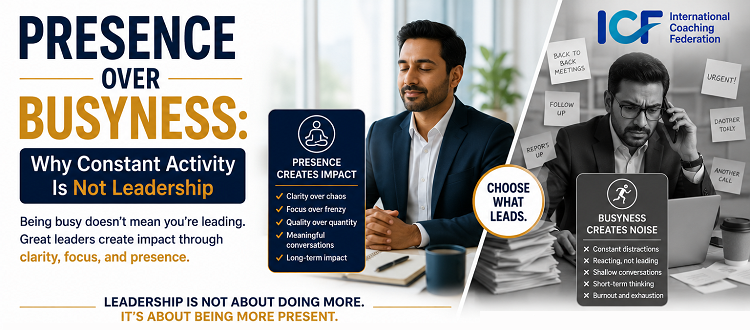
26 Jun Why Being Busy Isn’t the Same as Leading
The Modern Leadership Addiction
Ask a leader how they are doing and the answer is often immediate.
“Busy.”
Busy has become a badge of honour.
A sign of importance.
A measure of commitment.
A symbol of productivity.
Many leaders move from meeting to meeting, respond to messages throughout the day, and constantly juggle competing priorities.
Their calendars are full.
Their attention is fragmented.
Their days are packed.
Yet despite all this activity, many find themselves asking:
“Why do I still feel like I am not making meaningful progress?”
The answer may be simpler than it appears.
Being busy is not the same as being effective.
And constant activity is not the same as leadership.
The Illusion of Productivity
Modern work environments reward visible activity.
Quick responses.
Back-to-back meetings.
Immediate availability.
Rapid execution.
These behaviours create the impression of productivity.
But leadership is not measured by how much activity occurs.
Leadership is measured by the quality of decisions, conversations, relationships, and outcomes that emerge from that activity.
Sometimes the most important leadership work happens when nothing visible is happening at all.
When a leader is thinking.
Reflecting.
Observing.
Listening.
Creating clarity.
Why Leaders Become Trapped in Busyness
Busyness often begins with good intentions.
Leaders want to support their teams.
They want to solve problems.
They want to remain accessible.
They want to contribute.
Over time, however, busyness becomes habitual.
Many leaders begin responding to every request.
Attending every meeting.
Reviewing every detail.
Approving every decision.
The day becomes filled with activity but increasingly disconnected from purpose.
The leader becomes occupied without necessarily becoming effective.
Presence Is Different
Presence is not about doing less.
Presence is about being fully available to what matters most.
A present leader:
- Listens deeply
- Notices what others miss
- Pays attention to patterns
- Creates space for reflection
- Responds intentionally rather than reactively
Presence allows leaders to see beyond the immediate issue and understand the broader context.
It helps them distinguish between what is urgent and what is important.
Why Presence Matters
The quality of leadership is often determined by the quality of attention.
Leaders influence people not only through what they say, but through how they show up.
Teams notice when leaders are distracted.
They notice when leaders are rushing.
They notice when leaders are mentally somewhere else.
Likewise, they notice when leaders are fully present.
When leaders listen without interruption.
When they ask thoughtful questions.
When they create space for genuine dialogue.
Presence builds trust in ways that activity never can.
Busyness Creates Reaction
When leaders operate in constant busyness, they spend much of their time reacting.
Emails dictate priorities.
Meetings dictate attention.
Other people’s agendas determine the day.
The leader becomes pulled from one issue to another.
This reactive mode leaves little room for:
- Strategic thinking
- Creativity
- Learning
- Innovation
- Long-term vision
Eventually, leaders become highly efficient at responding to the present while becoming disconnected from the future.
Presence Creates Clarity
Presence slows leadership down just enough for clarity to emerge.
It creates moments where leaders can ask:
- What truly matters here?
- What is the real issue?
- What am I not seeing?
- What would create the greatest impact?
These questions rarely emerge in the middle of constant activity.
They emerge when there is space to think.
Leadership Is Not Measured by Motion
Many leaders confuse motion with progress.
The calendar is full.
The inbox is active.
The phone never stops.
Everything appears to be moving.
Yet movement alone does not guarantee meaningful progress.
Leadership requires direction.
It requires discernment.
It requires intentionality.
Sometimes the most courageous leadership decision is not to do more.
It is to pause long enough to determine what is truly necessary.
From Doing to Being
One of the most profound leadership transitions involves moving from constant doing toward intentional being.
This does not mean becoming passive.
It means leading from awareness rather than habit.
From purpose rather than pressure.
From clarity rather than urgency.
The shift is subtle.
Yet its impact is significant.
Leaders who develop presence often discover that they need less effort to create greater impact.
Practical Ways to Cultivate Presence
Presence is not a personality trait.
It is a practice.
Leaders can strengthen it by:
- Creating reflection time each day
- Entering meetings with clear intention
- Listening fully before responding
- Reducing unnecessary distractions
- Pausing before making important decisions
- Paying attention to their own internal state
Small practices, consistently applied, create profound changes over time.
Final Thoughts
Busyness is easy to measure.
Presence is not.
Yet presence often creates the conditions for better decisions, stronger relationships, and more sustainable leadership.
The most effective leaders are not necessarily the busiest people in the organization.
They are often the people who bring the greatest clarity to complexity.
Leadership is not about being everywhere.
It is about being fully present where it matters most.
Because in the end, people rarely remember how busy a leader was.
They remember how that leader made them think, feel, grow, and perform.
And that begins with presence.
About AlphaStars Academy of Excellence
At AlphaStars Academy of Excellence, we help leaders develop the awareness, presence, and inner alignment required to lead effectively in an increasingly complex world. Through coaching, leadership development, and InnerMost Shift™ methodologies, we support leaders in moving beyond busyness toward clarity, purpose, and sustainable impact.
Sorry, the comment form is closed at this time.