

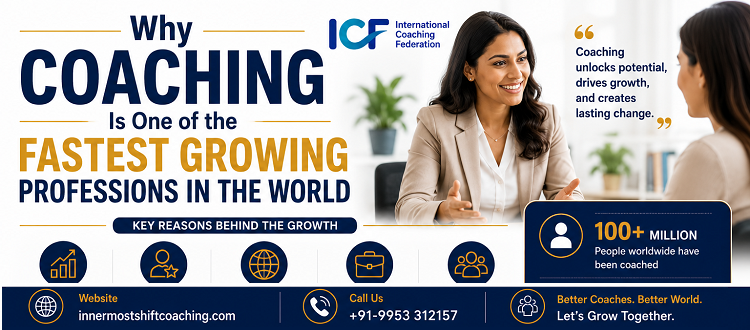
03 Jul Why Coaching Is One of the Fastest Growing Professions in the World
Understanding the Global Rise of Coaching
Not long ago, coaching was viewed as a niche profession.
It was often associated with elite athletes, senior executives, or individuals seeking personal development.
Today, the landscape looks very different.
Organizations are investing in coaching.
Leaders are hiring coaches.
Managers are learning coaching skills.
Teams are being coached.
Even entrepreneurs, healthcare professionals, educators, and HR leaders are embracing coaching as a powerful approach to growth and development.
The coaching profession has moved from the margins to the mainstream.
The question is no longer whether coaching is growing.
The question is:
Why is coaching becoming one of the fastest growing professions in the world?
The answer lies in a combination of changing workplace realities, increasing complexity, and a growing recognition that sustainable performance depends on human development.
The Numbers Tell a Powerful Story
According to the latest Global Coaching Study published by the International Coaching Federation (ICF), the coaching profession continues to experience significant growth worldwide. The global number of coach practitioners has reached a record 122,974 coaches worldwide, representing a 15% increase since 2023 and a remarkable 54% increase since 2019.
The economic impact is equally impressive.
The global coaching profession generated approximately USD 5.34 billion in annual revenue, reflecting continued expansion of coaching services across industries and regions.
These figures are particularly noteworthy because they reflect growth during a period marked by global uncertainty, technological disruption, changing workforce expectations, and evolving leadership challenges.
The World Has Become More Complex
The traditional leadership model was built for a more predictable world.
Leaders were expected to:
- Have answers
- Provide direction
- Solve problems
- Make decisions
Today’s environment is different.
Organizations face:
- Rapid technological change
- Global competition
- Hybrid work environments
- Generational shifts
- Increasing uncertainty
No leader possesses all the answers anymore.
Success increasingly depends on the ability to think, learn, adapt, and collaborate effectively.
This is precisely where coaching creates value.
Rather than providing answers, coaching helps individuals and teams develop the awareness, thinking, and capability needed to navigate complexity.
Organizations Are Investing More in Human Development
Modern organizations increasingly recognize that sustainable success is not created by processes alone.
It is created by people.
As a result, companies are investing heavily in:
- Leadership development
- Executive coaching
- Internal coaching cultures
- Team coaching
- Talent development
Many organizations now view coaching as a strategic investment rather than an optional benefit.
The focus has shifted from simply improving performance to building long-term capability, resilience, adaptability, and leadership effectiveness.
The Shift from Managing to Coaching
One of the most significant workplace trends is the movement from traditional management toward coaching-oriented leadership.
Employees today expect more than instructions.
They want:
- Development
- Empowerment
- Autonomy
- Meaningful conversations
- Growth opportunities
As a result, leaders are increasingly being trained in coaching skills.
Organizations have discovered that coaching conversations often create:
- Greater ownership
- Better engagement
- Improved problem-solving
- Stronger accountability
- Higher performance
The ability to coach has become a leadership advantage.
People Are Seeking More Meaningful Careers
Another reason coaching is growing rapidly is that many professionals are searching for work that feels meaningful.
After years in corporate roles, many individuals begin asking:
- How can I make a greater impact?
- How can I help others grow?
- How can I use my experience differently?
Coaching offers an opportunity to work at the intersection of human development, leadership, learning, and transformation.
For many professionals, coaching becomes a second career that combines purpose with professional expertise.
Coaching Produces Measurable Results
The popularity of coaching is not based on trends alone.
Organizations continue investing in coaching because they see results.
Research consistently shows that coaching can support:
- Leadership effectiveness
- Communication
- Decision-making
- Goal achievement
- Employee engagement
- Performance improvement
As awareness of coaching’s benefits grows, demand continues to expand.
Team Coaching Is Creating the Next Wave of Growth
For many years, coaching focused primarily on individuals.
Today, organizations are increasingly recognizing that individual excellence alone is not enough.
Teams must also perform effectively.
This has led to rapid growth in:
- Team coaching
- Systemic coaching
- Collective leadership development
The coaching profession is expanding beyond individual transformation toward collective transformation.
Many industry experts believe team coaching will become one of the most important growth areas within the profession over the coming decade.
Why Professional Standards Matter More Than Ever
As coaching grows, so does the need for professional standards.
One of the challenges of an expanding profession is that almost anyone can call themselves a coach.
This is why organizations and clients increasingly look for coaches who have completed professional coach education and obtained recognized credentials.
The International Coaching Federation (ICF) has played a significant role in advancing coaching standards globally through:
- Coaching competencies
- Ethical guidelines
- Credentialing pathways
- Coach education accreditation
Professional standards help build trust and ensure that coaching continues to mature as a profession.
Coaching Is No Longer Just for Coaches
One of the most interesting developments is that people are enrolling in coach training even when they do not intend to become full-time coaches.
Today, coaching skills are valued by:
- Leaders
- Managers
- HR professionals
- Consultants
- Trainers
- Educators
- Entrepreneurs
People are discovering that coaching is not simply a profession.
It is also a powerful leadership and communication capability.
The Future Looks Bright
According to the latest ICF research, optimism about the future of coaching remains high globally, with many coaches expecting continued growth in demand and revenue.
As organizations continue navigating uncertainty, change, and complexity, the need for people who can facilitate awareness, growth, learning, and transformation is likely to increase.
The future of work requires more than technical expertise.
It requires the ability to unlock human potential.
That is precisely where coaching creates value.
Final Thoughts
The rapid growth of coaching is not a passing trend.
It reflects a fundamental shift in how individuals, leaders, teams, and organizations approach growth and development.
The profession has expanded because the world has become more complex, leadership challenges have become more demanding, and people increasingly recognize the value of meaningful conversations that create awareness and change.
For those considering coaching as a profession, the opportunity has never been greater.
For leaders and organizations, the value of coaching has never been clearer.
And for society as a whole, the growing coaching profession represents something important:
A recognition that human potential is one of the most valuable resources we possess.
About AlphaStars Academy of Excellence
AlphaStars Academy of Excellence provides ICF-accredited coaching in India education that integrates the InnerMost Shift™ Coaching Model with authentic NLP certification, leadership development, emotional intelligence, somatic awareness, and transformational learning.
Participants learn directly from the founders and developers of the methodology, including Siri Guru Prakash Kaur Khalsa, Sat Puram Singh Khalsa, and Prosperity Jhunjhunwala, gaining practical education, mentoring, and developmental support throughout their coaching journey.
Sorry, the comment form is closed at this time.