
27 Jun Starting Your Coaching Journey with ACC Certification
Understanding the Foundation of an ICF Coaching Journey
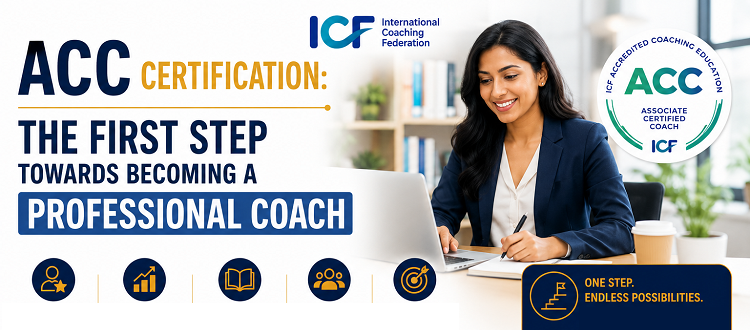
If you are exploring professional coaching as a career or looking to develop coaching skills as a leader, you have probably come across the term ACC Certification.
Many people hear terms such as ACC, PCC, and MCC and immediately become confused.
What do these credentials mean?
Which certification should you pursue?
Is ACC enough?
And perhaps most importantly:
How does ACC certification help you become a better coach?
This article aims to answer these questions and provide clarity for anyone considering a professional coaching journey.
What Is ACC Certification?
ACC stands for Associate Certified Coach.
It is the first level of professional coaching credential awarded by the entity[“organization”,“International Coaching Federation”,“Global coaching professional body”] (ICF), one of the world’s most recognized coaching organizations.
The ACC credential demonstrates that a coach has:
- Completed professional coach education
- Practiced coaching with real clients
- Developed coaching competence
- Demonstrated understanding of coaching ethics
- Met ICF’s credentialing standards
For many coaches around the world, ACC represents the beginning of a professional coaching journey.
Why Does ACC Certification Matter?
Coaching is an increasingly popular profession.
However, unlike professions such as medicine, law, or accounting, coaching remains largely unregulated in many parts of the world.
As a result, almost anyone can call themselves a coach.
This creates a challenge for clients.
How do they know whether a coach has received professional training?
How do they assess competence?
How do they distinguish between advice-giving and genuine coaching?
This is where professional credentials become valuable.
An ACC credential provides assurance that the coach has undergone structured learning, practice, mentoring, and assessment.
What Will You Learn During ACC Coach Training?
Many people assume coaching is simply asking questions.
In reality, professional coaching requires a sophisticated set of skills.
A quality ACC-level program helps participants learn how to:
Listen Deeply
Coaching goes beyond hearing words.
It involves listening for:
- Meaning
- Emotions
- Assumptions
- Patterns
- Possibilities
Ask Powerful Questions
Great coaching questions create awareness.
Instead of providing answers, coaches help clients discover their own insights.
Build Trust
Coaching conversations often involve uncertainty, vulnerability, and important life or leadership decisions.
Creating psychological safety becomes essential.
Facilitate Growth
Professional coaches help clients:
- Clarify goals
- Challenge assumptions
- Explore options
- Strengthen accountability
- Create meaningful action
Who Should Pursue ACC Certification?
Many people assume coach training is only for aspiring professional coaches.
In reality, ACC education benefits a wide range of professionals.
Leaders and Managers
Coaching skills help leaders develop people rather than simply direct them.
HR and Learning Professionals
Coaching enhances talent development, performance conversations, and employee engagement.
Consultants and Trainers
Coaching skills help create deeper and more sustainable change.
Aspiring Coaches
For individuals who wish to build a coaching practice, ACC often serves as the ideal starting point.
Is ACC Certification Enough?
A common question is:
“Should I stop at ACC or continue toward PCC?”
The answer depends on your goals.
ACC provides a strong foundation and is an excellent starting point.
Many coaches successfully build their careers after obtaining ACC.
However, as coaches gain experience, they often pursue PCC (Professional Certified Coach) to deepen their competence and credibility.
Think of ACC as learning the foundations of a profession.
PCC represents greater mastery developed through experience and continued learning.
Common Misconceptions About ACC Certification
Myth 1: ACC Makes You an Expert Coach Overnight
No certification can replace practice.
ACC provides a strong foundation, but coaching mastery develops through experience, reflection, mentoring, and continuous learning.
Myth 2: Coaching Is About Giving Advice
Professional coaching is not consulting.
It is not mentoring.
It is not teaching.
Coaching helps clients access their own wisdom and create their own solutions.
Myth 3: Coaching Skills Are Only Useful for Coaches
Many leaders discover that coach training transforms how they lead, communicate, delegate, and develop others.
Choosing the Right ACC Program
Not all coaching programs are the same.
Before enrolling, consider:
- Faculty experience
- Learning methodology
- Practice opportunities
- Mentor coaching support
- Feedback mechanisms
- Community and peer learning
A quality program should help you become a more capable coach, not simply provide a certificate.
Beyond Certification: The Real Transformation
One of the most surprising outcomes of coach training is that participants often experience significant personal growth themselves.
As they learn to coach others, they begin to:
- Increase self-awareness
- Improve communication
- Strengthen relationships
- Manage emotions more effectively
- Think more intentionally
The journey often transforms the coach as much as the clients they eventually serve.
Final Thoughts
ACC certification is more than a credential.
It is an invitation into a profession dedicated to human growth, learning, and transformation.
Whether your goal is to build a coaching practice, become a stronger leader, support people development, or expand your professional capabilities, ACC provides a strong foundation for that journey.
The credential may be the starting point.
The real value lies in the awareness, skills, and transformation that develop along the way.
About AlphaStars Academy of Excellence
AlphaStars Academy of Excellence provides ICF-accredited coach education designed to help leaders, professionals, and aspiring coaches develop coaching mastery while deepening self-awareness and transformational capability. Our programs integrate professional coaching competencies, InnerMost Shift™ methodologies, NLP, and leadership development to create coaches who can support meaningful and sustainable change.
Sorry, the comment form is closed at this time.