
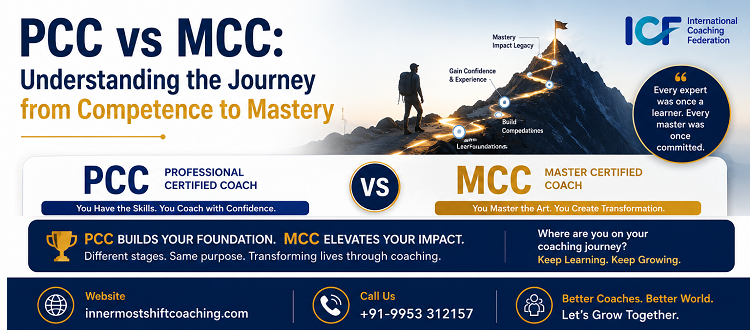
01 Jul PCC vs MCC: Understanding the Journey from Competence to Mastery
What Separates a Professional Coach from a Master Coach?
Among coaches, few questions generate more curiosity than:
What is the difference between PCC and MCC?
Both credentials are highly respected within the coaching profession.
Both demonstrate significant coaching competence.
Yet coaches who have experienced MCC-level coaching often describe something distinctly different.
The difference is rarely about techniques.
It is rarely about models.
And it is certainly not just about coaching hours.
The distinction often lies in the coach’s presence, awareness, partnership, and ability to facilitate transformational conversations.
Understanding PCC
PCC (Professional Certified Coach) is widely regarded as the professional benchmark within the coaching industry.
A PCC coach generally requires:
Coach Education
- Minimum 125 hours of coach-specific education
Coaching Experience
- Minimum 500 coaching hours
- Minimum 25 clients
Additional Requirements
- Mentor Coaching
- Successful completion of ICF credentialing requirements
PCC demonstrates strong coaching competence and professional credibility.
Understanding MCC
MCC (Master Certified Coach) is the highest credential awarded by the International Coach Federation.
Importantly:
A coach must already hold a PCC credential before pursuing MCC.
MCC is not an alternative pathway.
It is the next stage of professional development.
To obtain an MCC credential, coaches generally require:
Coach Education
- Minimum 200 hours of coach-specific education
Coaching Experience
- Minimum 2,500 coaching hours
- Minimum 35 clients
Additional Requirements
- Advanced demonstration of coaching mastery
- Successful MCC performance evaluation
MCC represents a level of mastery achieved by only a small percentage of coaches worldwide.
Why MCC Is Not Just More Experience
Many people assume MCC is simply PCC plus additional coaching hours.
This assumption misses the essence of mastery.
At PCC level, coaches often demonstrate:
- Strong coaching structure
- Effective competency application
- Consistent coaching quality
- Professional coaching conversations
At MCC level, coaches often demonstrate:
- Extraordinary presence
- Deep trust in the coaching process
- Comfort with uncertainty
- Minimal attachment to outcomes
- Exceptional partnership with clients
- Transformational awareness
The coaching conversation becomes less about technique and more about the quality of being.
The Shift from Doing Coaching to Being a Coach
One of the most significant differences between PCC and MCC lies in how the coach experiences the conversation.
PCC Coaches Often Ask
“What coaching skill should I use here?”
MCC Coaches Often Ask
“What is trying to emerge here?”
PCC coaches demonstrate competence.
MCC coaches embody coaching.
This distinction may seem subtle.
Yet it changes everything.
Presence Becomes the Intervention
At earlier stages, coaches often rely heavily on models, tools, frameworks, and techniques.
As mastery develops, coaches discover something surprising.
Their presence itself becomes a powerful intervention.
The ability to:
- Stay fully present
- Hold uncertainty
- Trust silence
- Listen beyond words
- Partner deeply
often creates transformational outcomes without needing complex techniques.
Is MCC Right for Every Coach?
Not necessarily.
Many highly successful coaches remain PCC credential holders throughout their careers.
PCC provides significant credibility and competence.
MCC is often pursued by coaches who feel called toward mastery, contribution, and deeper professional development.
It is less about achievement and more about embodiment.
The Journey Never Ends
One of the most interesting aspects of MCC coaches is that many do not consider themselves finished.
They continue learning.
They continue reflecting.
They continue growing.
Mastery is not a destination.
It is an ongoing practice.
The credential simply reflects a level of development reached at a particular moment in time.
Final Thoughts
PCC and MCC are not competing credentials.
They represent different stages of a coach’s evolution.
PCC demonstrates professional coaching competence.
MCC reflects coaching mastery embodied through awareness, presence, partnership, and transformational capability.
The difference is not merely what the coach does.
The difference is who the coach has become.
And perhaps that is the most meaningful journey in coaching of all.
Frequently Asked Questions (FAQs)
1. What is the difference between PCC and MCC in ICF coaching?
PCC (Professional Certified Coach) demonstrates advanced coaching competence, while MCC (Master Certified Coach) represents the highest level of ICF coaching credential. MCC coaches consistently demonstrate exceptional coaching presence, deep partnership with clients, and the ability to facilitate profound transformational change.
2. Is MCC better than PCC?
MCC is the highest credential offered by the International Coach Federation (ICF), but it is not simply a “better” version of PCC. It reflects years of coaching experience, continuous professional development, and mastery of coaching competencies. The right credential depends on your stage of professional growth and career goals.
3. How do I progress from PCC to MCC?
To progress from PCC to MCC, coaches must meet the ICF’s advanced credentialing requirements, including additional coach-specific education, extensive coaching experience, mentor coaching, and successfully demonstrating mastery-level coaching competencies through the ICF assessment process.
4. Do clients look for MCC-certified coaches?
Many organizations and executive clients value MCC-certified coaches because the credential signifies the highest standard of professional coaching. However, clients ultimately choose coaches based on trust, coaching effectiveness, experience, and the ability to deliver meaningful results, regardless of the credential level.
About AlphaStars Academy of Excellence
At AlphaStars Academy of Excellence, we support coaches at every stage of their professional journey—from foundational coach training to advanced mastery development. Our programs integrate ICF competencies, InnerMost Shift™ methodologies, NLP, leadership development, mentoring, and reflective practice to support sustainable coaching excellence.
Sorry, the comment form is closed at this time.