

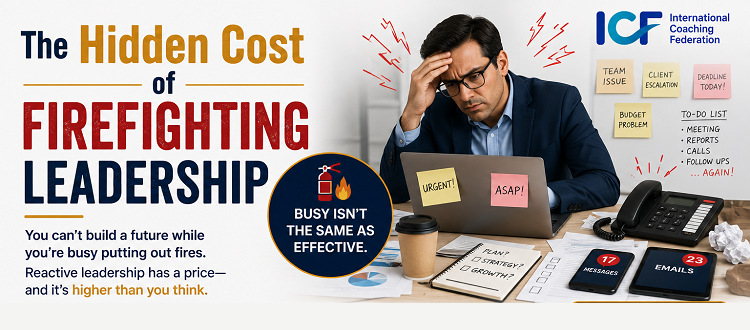
24 Jun What Constant Firefighting Really Costs Leaders
Why Solving More Problems Is Not Always Better Leadership
Many leaders pride themselves on their ability to solve problems quickly.
When something goes wrong, they step in.
When a customer escalates an issue, they intervene.
When a team member is stuck, they provide answers.
When a crisis emerges, they take charge.
Initially, this behaviour is often rewarded.
The leader is seen as dependable, responsive, and capable.
People appreciate having someone who can handle difficult situations.
Over time, however, a subtle shift begins to occur.
The leader becomes the person everyone depends upon.
Every important issue reaches their desk.
Every difficult decision requires their approval.
Every crisis demands their involvement.
Without realizing it, the leader becomes the centre of the organization’s problem-solving system.
This is the beginning of what many organizations unknowingly celebrate: firefighting leadership.
Why Firefighting Feels Productive
Firefighting creates a powerful sense of accomplishment.
Problems are visible.
Solutions are immediate.
Results are tangible.
At the end of the day, leaders can point to numerous issues they resolved.
This creates an illusion of effectiveness.
The leader feels busy.
The organization feels supported.
Everyone believes progress is being made.
Yet an important question often remains unasked:
Why do the same fires keep appearing?
The Difference Between Solving Problems and Leading
Leadership and problem-solving are not the same thing.
Problem-solving addresses symptoms.
Leadership addresses causes.
Problem-solving focuses on immediate issues.
Leadership focuses on long-term capability.
Problem-solving removes obstacles.
Leadership creates conditions where obstacles occur less frequently.
When leaders spend most of their time solving today’s emergencies, they have little time left to shape tomorrow’s success.
The Hidden Costs of Firefighting
The consequences of firefighting leadership are rarely visible immediately.
They accumulate slowly.
Strategic Thinking Suffers
When leaders spend every day reacting to urgent issues, there is little space for reflection.
Long-term planning gets postponed.
Innovation receives less attention.
Important but non-urgent work remains unfinished.
Eventually, the organization becomes excellent at handling today’s problems but poorly prepared for tomorrow’s opportunities.
Teams Become Dependent
Every time a leader provides an answer too quickly, a learning opportunity disappears.
Team members gradually become conditioned to seek solutions rather than create them.
Questions flow upward.
Ownership decreases.
Initiative declines.
The leader becomes increasingly overloaded while the team’s capability grows more slowly than it should.
Decision Bottlenecks Emerge
Many organizations unknowingly create a situation where decisions cannot move forward without the leader.
People wait for approval.
Projects slow down.
Momentum decreases.
Ironically, the leader who wants things to move faster becomes the very factor limiting progress.
Stress Becomes Normal
Constant firefighting keeps leaders in a reactive state.
Every day feels urgent.
Every issue feels critical.
Over time, this environment creates fatigue, frustration, and burnout.
Leaders begin surviving rather than leading.
Why Organizations Reward Firefighters
One reason firefighting persists is because organizations often celebrate it.
The person who saves the day receives recognition.
The leader who resolves a crisis is praised.
The manager who works late to fix problems is admired.
Rarely do organizations celebrate the leader who quietly prevented the crisis from happening in the first place.
As a result, many leaders become trapped in a cycle where they are rewarded for fixing problems rather than eliminating the conditions that create them.
The Shift from Firefighter to Strategic Leader
Every leader eventually reaches a point where working harder is no longer the answer.
The next level of leadership requires a different question.
Instead of asking:
“How do I solve this problem?”
The leader begins asking:
“Why does this problem keep occurring?”
This shift changes everything.
The focus moves from reaction to prevention.
From activity to impact.
From solving to enabling.
From dependence to ownership.
Creating a Culture of Ownership
One of the most powerful leadership shifts occurs when leaders stop being the first source of answers.
Instead, they become facilitators of thinking.
When team members bring a problem, the leader asks:
- What options have you considered?
- What do you recommend?
- What information might help you decide?
- What can we learn from this situation?
These conversations strengthen capability rather than dependency.
Over time, the team becomes more resourceful, confident, and accountable.
The Leadership Question That Matters
Every leader should periodically ask:
“If I stepped away for two weeks, what would stop functioning?”
The answer often reveals where dependence exists.
The goal of leadership is not to become indispensable.
The goal is to create systems, people, and processes that continue to perform effectively even when the leader is absent.
Final Thoughts
Firefighting is sometimes necessary.
Crises happen.
Urgent situations arise.
Leaders must occasionally step in.
The danger occurs when firefighting becomes the primary leadership style.
Organizations do not become exceptional because leaders solve every problem.
They become exceptional because leaders create environments where fewer problems occur, people take ownership, and teams become capable of navigating challenges independently.
The true measure of leadership is not how many fires you can extinguish.
It is how effectively you help prevent them from starting in the first place.
About AlphaStars Academy of Excellence
At AlphaStars Academy of Excellence, we work with leaders, founders, and executives to move beyond reactive leadership and develop the awareness, capability, and strategic thinking required for sustainable success. Through coaching, leadership development, and InnerMost Shift™ methodologies, we help leaders create greater impact without carrying the entire burden alone.
Sorry, the comment form is closed at this time.