

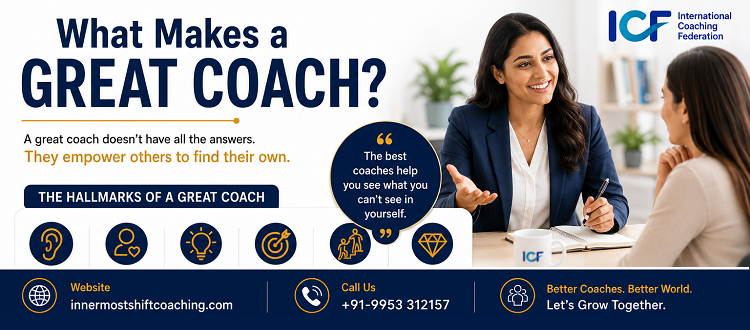
16 Jul What Makes a Great Coach?
Beyond Certifications and Credentials Why Some Coaches Create Transformation While Others Simply Have Certifications
The coaching profession has grown rapidly over the last decade.
Today, there are thousands of coaching programs, certifications, credentials, and specializations available across the world.
As coaching continues to gain popularity, many aspiring coaches naturally ask:
“What makes a great coach?”
Is it the number of certifications?
The coaching model?
The credential level?
The number of coaching tools?
The answer may surprise you.
While education, credentials, and competencies are important, they are only part of the picture.
Some coaches collect certifications yet struggle to create meaningful impact.
Others consistently help clients achieve powerful insights, lasting behavioural change, and profound transformation.
The difference often lies not in what the coach knows, but in who the coach has become.
Certifications Matter—But They Are Only the Beginning
Professional coach education is important.
Organizations such as the International Coaching Federation (ICF) have established valuable standards that help ensure coaching quality, ethics, and competence.
Credentials such as:
- ACC
- PCC
- MCC
provide evidence of professional development and commitment to coaching excellence.
However, certifications alone do not create coaching mastery.
Just as attending medical school does not immediately create a great doctor, completing coach training does not automatically create a great coach.
Mastery develops through:
- Practice
- Reflection
- Feedback
- Awareness
- Experience
- Continuous learning
Credentials open the door.
Development happens after entering the room.
Great Coaches Listen Beyond Words
Most people listen to respond.
Great coaches listen to understand.
They listen not only to what is being said but also to:
- What is not being said
- Emotional undertones
- Assumptions
- Beliefs
- Contradictions
- Patterns
Clients often arrive believing their challenge is external.
Through deep listening, great coaches help clients discover that the real opportunity often lies within their own thinking, perception, or behaviour.
Listening becomes more than a skill.
It becomes a way of being.
Great Coaches Create Awareness
Many people assume coaching is about helping clients achieve goals.
While goals matter, transformational coaching begins elsewhere.
It begins with awareness.
Before behaviour changes, awareness must emerge.
Before new choices become possible, old assumptions must become visible.
Great coaches help clients see:
- Patterns they have never noticed
- Beliefs they have never questioned
- Possibilities they have never considered
The quality of awareness often determines the quality of transformation.
Great Coaches Are Curious, Not Certain
One of the most common mistakes new coaches make is trying to be helpful too quickly.
They offer suggestions.
Share experiences.
Recommend solutions.
Great coaches take a different approach.
They remain curious.
They recognize that every client experiences reality differently.
Rather than assuming they know the answer, they explore.
Their mindset becomes:
“Help me understand.”
Curiosity creates discovery.
Certainty often limits it.
Great Coaches Trust Their Clients
Many helping professions are built around solving problems.
Coaching is different.
Professional coaching operates from a powerful assumption:
People are more resourceful than they often realize.
Great coaches trust their clients’ ability to think, learn, decide, and grow.
They do not become responsible for the client’s life.
They become responsible for the quality of the coaching partnership.
This distinction is fundamental.
Great Coaches Are Comfortable with Not Knowing
Many aspiring coaches worry about not having enough answers.
Ironically, one of the hallmarks of coaching mastery is becoming comfortable with uncertainty.
Great coaches do not need to appear clever.
They do not need to demonstrate expertise in every topic.
They trust the coaching process.
They trust the client.
They trust emergence.
Sometimes the most powerful coaching moments arise when neither the coach nor the client knows exactly where the conversation is heading.
Great Coaches Develop Coaching Presence
Presence is one of the most underestimated coaching capabilities.
Clients can sense when a coach is distracted.
They can sense when a coach is thinking about the next question.
They can sense when a coach is following a script.
Great coaches bring full attention to the conversation.
They are:
- Focused
- Open
- Curious
- Non-judgmental
- Fully engaged
Presence creates safety.
Safety creates trust.
Trust creates transformation.
Great Coaches Understand Human Behaviour
Coaching is ultimately about helping people create change.
To do this effectively, coaches benefit from understanding how people think, feel, communicate, decide, and behave.
This is one reason why many successful coaches study disciplines such as:
- Psychology
- Neuroscience
- Emotional Intelligence
- Behavioural Science
- NLP (Neuro-Linguistic Programming)
When used ethically and responsibly, NLP can provide valuable insights into:
- Belief systems
- Language patterns
- Behavioural preferences
- Motivation
- Decision-making processes
- Personal change
Understanding human behaviour allows coaches to partner with clients more effectively and facilitate deeper awareness.
Great Coaches Continue Developing Themselves
The best coaches never stop learning.
The coaching profession itself reflects this principle.
Many coaches progress through stages such as:
- ACC
- PCC
- MCC
Yet mastery is not simply about collecting credentials.
It involves continuously refining:
- Awareness
- Presence
- Listening
- Partnership
- Emotional maturity
- Coaching judgement
The most effective coaches often remain lifelong students of human development.
Great Coaches Do Their Own Inner Work
This may be the most overlooked aspect of coaching excellence.
Every coach brings themselves into the conversation.
Their beliefs.
Their fears.
Their assumptions.
Their habits.
Their worldview.
The more aware coaches become of their own internal patterns, the less likely those patterns are to interfere with the coaching relationship.
This is why personal development and coaching development are often deeply interconnected.
Many coaches discover that the journey of becoming a better coach is inseparable from the journey of becoming a more conscious human being.
Beyond Competence: Toward Coaching Mastery
Competence is important.
Every coach should develop strong coaching skills and professional standards.
However, coaching mastery extends beyond competence.
Masterful coaches combine:
- Skill
- Presence
- Awareness
- Curiosity
- Partnership
- Emotional maturity
- Understanding of human behaviour
Their impact comes not merely from what they do.
It comes from how they show up.
Final Thoughts
In today’s coaching marketplace, certifications and credentials matter.
They provide standards, structure, and professional credibility.
Yet the qualities that truly distinguish great coaches are often less visible.
Great coaches listen deeply.
They create awareness.
They trust their clients.
They remain curious.
They continue learning.
And perhaps most importantly, they continue growing themselves.
Because in the end, coaching is not simply a profession.
It is a practice of helping human beings discover possibilities they could not see before.
And that requires much more than a certificate.
It requires presence, awareness, and a genuine commitment to human growth.
About AlphaStars Academy of Excellence
AlphaStars Academy of Excellence provides ICF-accredited coach training in India education that integrates professional coaching competencies with the InnerMost Shift™ Coaching Model, authentic NLP certification, leadership development, emotional intelligence, and transformational learning.
Participants learn directly from the founders and developers of the methodology, including Siri Guru Prakash Kaur Khalsa (MCC), Sat Puram Singh Khalsa (MCC), and Prosperity Jhunjhunwala (PCC). Through coach education, mentoring, supervision, and experiential learning, participants develop not only coaching competence but also a deeper understanding of human behaviour, awareness, and transformation.
Sorry, the comment form is closed at this time.