

11 Jul The Hidden Forces That Keep People Stuck in Old Patterns
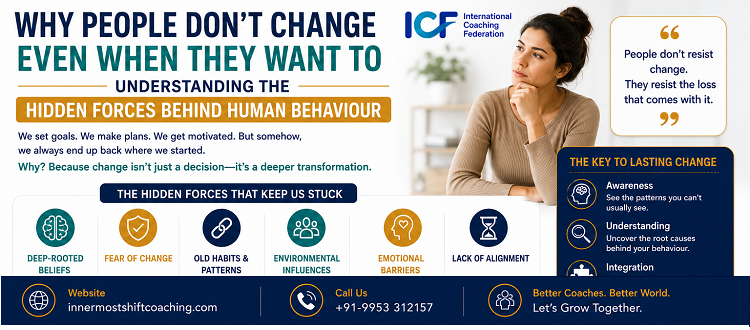
Why People Don’t Change Even When They Want To Understanding the Hidden Forces Behind Human Behaviour
Have you ever found yourself saying:
- “I know what I should do, but I am not doing it.”
- “I have tried to change many times, but I keep slipping back.”
- “I want to move forward, yet something keeps holding me back.”
If so, you are not alone.
In fact, one of the greatest mysteries of human behaviour is this:
People often fail to change even when they genuinely want to.
They want to exercise.
They want to eat healthier.
They want to stop procrastinating.
They want to delegate more.
They want to be confident.
They want to improve relationships.
And yet, despite good intentions, motivation, and awareness, lasting change often remains elusive.
Why?
Is it a lack of discipline?
A lack of willpower?
A lack of commitment?
In most cases, the answer is no.
The reasons are often much deeper.
The Myth of Willpower
When people struggle to change, they often blame themselves.
They tell themselves:
- “I am lazy.”
- “I lack discipline.”
- “I need more motivation.”
- “I just need to try harder.”
While effort certainly plays a role, willpower alone rarely explains human behaviour.
If knowledge were enough, everyone would exercise regularly.
If motivation were enough, every New Year’s resolution would succeed.
If discipline were enough, behavioural change would be simple.
The reality is that human behaviour is influenced by forces operating beneath conscious awareness.
Every Behaviour Makes Sense to the Person Doing It
One of the most powerful insights from NLP (Neuro-Linguistic Programming) is that behaviour is rarely random.
Even behaviours that appear self-defeating often serve a purpose.
Consider procrastination.
From the outside, it may appear irrational.
Yet procrastination may be helping someone:
- Avoid failure
- Avoid criticism
- Avoid uncertainty
- Avoid discomfort
The behaviour may be creating a short-term sense of safety.
Similarly:
Perfectionism may protect someone from judgement.
People-pleasing may protect relationships.
Overworking may create a sense of significance.
Avoidance may reduce anxiety.
The behaviour may not be effective in the long run, but it often serves an important psychological purpose in the present.
The Principle of Positive Intention
One of the foundational ideas within NLP is that every behaviour has a positive intention.
This does not mean every behaviour is useful.
It means that somewhere beneath the behaviour, the person is attempting to achieve something valuable.
For example:
A leader who micromanages may be seeking certainty.
An employee who avoids difficult conversations may be seeking harmony.
A founder who struggles to delegate may be seeking quality.
A perfectionist may be seeking excellence.
The challenge is not the intention.
The challenge is the strategy being used to fulfil it.
When people recognize the positive intention behind a behaviour, change becomes easier because they can discover healthier ways to meet the same need.
The Real Battle Often Happens Inside
Many people experience internal conflict without realizing it.
One part of them wants growth.
Another part wants safety.
One part wants change.
Another part wants familiarity.
One part wants success.
Another part fears the consequences of success.
This creates a hidden tug-of-war.
For example:
A leader may consciously want to delegate.
Yet unconsciously fear losing control.
An entrepreneur may want business growth.
Yet fear increased responsibility.
A professional may want visibility.
Yet fear criticism.
Until these competing motivations are recognized, progress often feels slow and frustrating.
Why Advice Often Doesn’t Work
This is one reason advice frequently fails.
Advice usually focuses on behaviour.
“Be more confident.”
“Stop procrastinating.”
“Delegate more.”
“Think positively.”
While well-intentioned, advice often addresses the symptom rather than the structure beneath it.
Real change requires understanding:
- What the behaviour achieves
- What need it fulfils
- What belief supports it
- What fear sustains it
Without addressing these deeper layers, behaviour often returns to its original pattern.
The Role of Beliefs
Beliefs play a powerful role in shaping behaviour.
Many people attempt to change actions while leaving beliefs untouched.
Consider beliefs such as:
- “I am not good enough.”
- “People cannot be trusted.”
- “If I make mistakes, I will be judged.”
- “Success creates problems.”
- “Conflict is dangerous.”
Whether consciously acknowledged or not, beliefs influence decisions, emotions, and behaviour.
People often act consistently with what they believe rather than what they say they want.
This is why sustainable change frequently requires examining and updating limiting beliefs.
Identity Is Often Stronger Than Motivation
Another reason change becomes difficult is that behaviour is closely linked to identity.
People naturally act in ways that feel consistent with who they believe they are.
For example:
Someone who identifies as:
- “A procrastinator”
- “An anxious person”
- “A people pleaser”
- “Someone who lacks confidence”
may unconsciously continue behaving in ways that reinforce that identity.
Changing behaviour becomes easier when identity begins to shift.
The question moves from:
“What should I do?”
to
“Who am I becoming?”
This is often where transformational change begins.
Why Awareness Comes Before Change
Many people focus immediately on action.
They want techniques.
Strategies.
Tools.
Quick fixes.
Yet sustainable change usually follows a different sequence.
First: Awareness
Seeing the pattern.
Then: Understanding
Recognizing why it exists.
Then: Choice
Exploring alternatives.
Then: Action
Practicing new behaviours.
Without awareness, action often becomes temporary.
With awareness, change becomes more sustainable because it emerges from understanding rather than force.
What NLP Teaches Us About Change
One of the reasons NLP became so influential is its focus on understanding how people create their internal experience.
NLP suggests that behaviour is shaped by:
- Beliefs
- Language
- Internal representations
- Emotional associations
- Meaning-making processes
When these internal structures change, behaviour often changes naturally.
Instead of forcing different actions, people begin experiencing situations differently.
And when perception changes, behaviour frequently follows.
The Goal Is Not to Fight Yourself
Many personal development approaches encourage people to fight unwanted behaviours.
The challenge with this approach is that internal conflict often increases resistance.
A more effective approach is curiosity.
Instead of asking:
“Why am I like this?”
Ask:
“What is this behaviour trying to achieve?”
Instead of attacking the behaviour, seek to understand it.
Awareness often creates possibilities that force never can.
Final Thoughts
People do not usually resist change.
They resist losing something important.
Security.
Certainty.
Acceptance.
Control.
Belonging.
Understanding this distinction changes everything.
When we recognize that behaviour often serves a purpose, we become less judgmental and more curious.
And curiosity creates awareness.
Awareness creates choice.
Choice creates transformation.
Perhaps the challenge is not that people are unwilling to change.
Perhaps the challenge is that they have not yet discovered what part of them is trying to protect them from that change.
And once that becomes visible, new possibilities begin to emerge.
About AlphaStars Academy of Excellence
At AlphaStars Academy of Excellence, we believe lasting transformation occurs when people understand not only what they do, but why they do it. Our coach education programs integrate ICF coaching competencies, the InnerMost Shift™ Coaching Model, authentic NLP certification, leadership development, emotional intelligence, and deep self-awareness practices.
Participants learn directly from Siri Guru Prakash Kaur Khalsa (MCC), Sat Puram Singh Khalsa (MCC), and Prosperity Jhunjhunwala (PCC), gaining practical tools and transformational insights that support meaningful and sustainable change.
Sorry, the comment form is closed at this time.