

10 Jul Beyond the Mind: How Somatic Mindfulness Creates Real Change
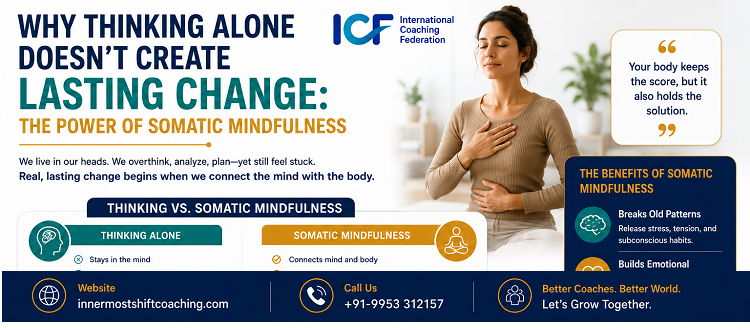
Why Thinking Alone Doesn’t Create Lasting Change: The Power of Somatic Mindfulness
Moving Beyond the Mind to Create Sustainable Transformation
When people want to create change, they usually begin in the same place.
They try to think differently.
They read books.
They attend workshops.
They learn new concepts.
They gather insights.
And yet, despite understanding what needs to change, many continue repeating the same patterns.
They still react under pressure.
They still procrastinate.
They still struggle with difficult conversations.
They still experience stress, self-doubt, or overwhelm.
This raises an important question:
If insight alone creates change, why do so many people continue doing what they know they should not do?
The answer may lie in a simple observation.
Human beings do not experience life through thoughts alone.
We experience life through our entire system.
Our body.
Our emotions.
Our sensory awareness.
Our experiences.
Our thinking.
Lasting transformation often requires working with all of them.
The Limitation of Cognitive Change
Modern education has trained us to believe that thinking is the primary pathway to change.
If we understand something, we should be able to change it.
Yet experience suggests otherwise.
Most people already know:
- Exercise is healthy.
- Stress is harmful.
- Sleep is important.
- Difficult conversations should not be avoided.
Knowledge is rarely the problem.
The challenge is that behaviour is often driven by forces operating beneath conscious thinking.
People may intellectually understand a situation while their body, emotions, and habitual responses continue operating from older patterns.
This is why awareness alone does not always create transformation.
The Body Remembers What the Mind Forgets
Think about a situation where you felt nervous before an important presentation.
Your thinking mind may have known:
“I am prepared.”
Yet your body may have experienced:
- Tight shoulders
- Shallow breathing
- Increased heart rate
- Restlessness
The body was communicating something important.
Many leaders experience the same phenomenon.
They may understand a concept intellectually while their physiology continues responding from habit, fear, stress, or past experience.
This is one reason sustainable change requires more than cognitive understanding.
It requires awareness of the entire human system.
What Is Somatic Mindfulness?
The word somatic comes from the Greek word soma, meaning body.
Somatic mindfulness involves paying attention not only to thoughts but also to bodily sensations, emotions, sensory awareness, and lived experience.
Rather than asking:
“What am I thinking?”
Somatic mindfulness also asks:
- What is happening in my body?
- What am I feeling?
- What sensory story am I creating?
- What experience am I having right now?
This broader awareness often reveals patterns that thinking alone cannot access.
The B.E.S.T.™ Framework for Somatic Awareness
At AlphaStars Academy of Excellence, the InnerMost Shift™ Coaching Model uses a simple yet powerful framework called B.E.S.T.™
B.E.S.T.™ invites people to explore four interconnected dimensions of human experience.
B – Body & Breath
The body often communicates before the mind becomes aware.
Questions include:
- What is happening in my body right now?
- How am I breathing?
- Where am I holding tension?
- What posture am I adopting?
- What is my energy level?
Many emotional and behavioural patterns first become visible through the body.
The body often reveals what the mind has not yet acknowledged.
E – Emotion, Experience & Expression
Emotions influence perception, decision-making, relationships, and behaviour.
Questions include:
- What am I feeling?
- What emotional state am I experiencing?
- What experience am I creating internally?
- What emotion is influencing my choices right now?
When emotions remain outside awareness, they often influence behaviour unconsciously.
Awareness creates the possibility of choice.
S – Sensory Story / Sensory Awareness
Human beings do not respond directly to reality.
They respond to the internal representation they create of reality.
Every experience is filtered through sensory awareness.
Questions include:
- What am I seeing internally?
- What am I hearing internally?
- What sensations am I noticing?
- What story am I creating from this experience?
Consider two leaders preparing for the same presentation.
One imagines failure.
Hears criticism.
Feels pressure.
The other imagines success.
Hears encouragement.
Feels energized.
The external event is identical.
The internal sensory story is different.
And that sensory story influences confidence, emotions, behaviour, and performance.
Developing sensory awareness helps people become conscious of the stories they are creating rather than assuming those stories are objective reality.
T – Thoughts & Thinking
Finally, attention turns toward thinking patterns.
Questions include:
- What am I telling myself?
- What assumptions am I making?
- What beliefs are influencing me?
- What interpretation am I holding?
- What meaning am I assigning to this situation?
Thinking remains important.
The difference is that it is explored alongside body, emotions, and sensory awareness rather than in isolation.
Why Leaders Need Somatic Awareness
Leadership is often viewed as a cognitive activity.
Decision-making.
Strategy.
Problem-solving.
Communication.
Yet leadership is also deeply embodied.
Leaders communicate through:
- Presence
- Energy
- Emotional regulation
- Tone of voice
- Body language
A leader may say they are calm while their physiology communicates anxiety.
A leader may talk about trust while unconsciously signalling defensiveness.
People respond not only to words but also to what is being communicated beneath the words.
Somatic awareness helps leaders align their internal state with their external impact.
From Reaction to Response
One of the greatest benefits of somatic mindfulness is the ability to notice patterns before they fully take over.
Many reactions happen automatically.
Something triggers us.
An emotion emerges.
A sensory story is created.
Thoughts follow.
Behaviour happens.
The entire sequence may unfold within seconds.
Somatic awareness slows the process just enough to create choice.
Instead of reacting automatically, individuals gain the ability to respond intentionally.
This small shift often creates profound changes in leadership, relationships, and performance.
Sustainable Change Involves the Whole Person
Many development approaches focus primarily on thinking.
While thinking matters, sustainable transformation often involves:
- Body awareness
- Emotional awareness
- Sensory awareness
- Cognitive awareness
When all four dimensions become aligned, change tends to feel less forced and more natural.
The goal is not to control ourselves.
The goal is to understand ourselves more deeply.
The Future of Human Development
Increasingly, leadership development, coaching, neuroscience, mindfulness, and behavioural science are converging around a similar insight:
Human beings are integrated systems.
Lasting transformation occurs when awareness expands beyond thinking alone.
People grow not simply by learning new ideas.
They grow by becoming aware of how they experience themselves, others, and the world.
Somatic mindfulness provides a pathway into that deeper awareness.
Final Thoughts
Many people spend years trying to change their behaviour through willpower and positive thinking alone.
Sometimes it works.
Often it does not.
The reason is simple.
Human beings are more than their thoughts.
We are embodied, emotional, sensory, meaning-making beings.
When we learn to listen not only to our minds but also to our bodies, emotions, sensory stories, and lived experience, new possibilities begin to emerge.
The journey of transformation becomes less about forcing change and more about creating awareness.
And awareness remains the starting point of every meaningful shift.
About AlphaStars Academy of Excellence
At AlphaStars Academy of Excellence, our InnerMost Shift™ Coaching Model integrates professional coaching, authentic NLP certification, leadership development, and somatic mindfulness practices.
Through the B.E.S.T.™ Framework—Body & Breath, Emotion & Experience, Sensory Story & Awareness, and Thoughts & Thinking—we help leaders, coaches, and professionals develop deeper self-awareness and create sustainable transformation from the inside out.
Participants learn directly from Siri Guru Prakash Kaur Khalsa (MCC), Sat Puram Singh Khalsa (MCC), and Prosperity Jhunjhunwala (PCC), combining professional excellence with personal mastery.
Sorry, the comment form is closed at this time.